


Discover rich geological and cultural landscapes of Lang Son
From majestic limestone mountain ranges and lush green
valleys to tranquil stilt houses, Lang Son is gradually
shaping a new tourism landscape - where nature, local
culture, and community livelihoods combine to create an
irresistible attraction.
Beyond familiar landmarks like Mau Son, Bac Son, Dong Kinh
Market, and vibrant festivals, this border region also
boasts a unique system of geological, ecological, and
cultural landscapes. The recognition of Lang Son Geopark as
a UNESCO Global Geopark will be a highlight in Lang Son's
efforts to attract more tourists. This international
designation acknowledges the outstanding geological,
landscape, ecological, and cultural values of Lang Son,
while also opening up opportunities for the locality to
develop tourism in a more sustainable direction.
According to the Department of Culture, Sports and Tourism
of Lang Son province, to promote and attract tourists to the
local geopark, the province will develop and propose the
issuance of a set of criteria for model communes, wards,
villages, hamlets, and neighborhoods with innovative,
effective, and comprehensive approaches in preserving,
restoring, and promoting the value of the UNESCO Lang Son
Global Geopark, and will pilot several models; continue to
focus on improving the quality of activities at 38 tourist
attractions on 4 tourist routes of the UNESCO Lang Son
Global Geopark. In addition, Lang Son province will
implement the following projects: Developing a Geopark
Tourist Attraction Handbook; Upgrading the Website for the
UNESCO Lang Son Global Geopark; Designing and producing
souvenirs and uniforms for the UNESCO Lang Son Global
Geopark; Forming and operating a GeoKids space…
Leaving the bustling streets, the journey to Huu Lien
takes visitors to a completely different landscape:
limestone mountains surrounding green valleys, fields
stretching at the foot of the mountains, streams winding
through villages, and stilt houses nestled peacefully amidst
the lush greenery.
Huu Lien is located in an area with high biodiversity and
karst landscape value, and is part of the UNESCO Lang Son
Global Geopark. The system of limestone mountains, forests,
caves, underground streams, and seasonally flooded lakes
creates a unique ecological space.
But what makes Huu Lien different is not just its scenery.
It's also about how the local people are transforming the
inherent values of their homeland into tourism products.
Visitors can stay in traditional stilt houses, enjoy local
cuisine, explore the villages on foot, cycle through the
valleys, kayak on the water, camp amidst nature, or simply
sit on the porch, listen to the wind, and chat with the
locals. If Huu Lien is a harmonious blend of nature and
community culture, then the Dong Lam grassland is one of the
highlights that creates the brand of this land.
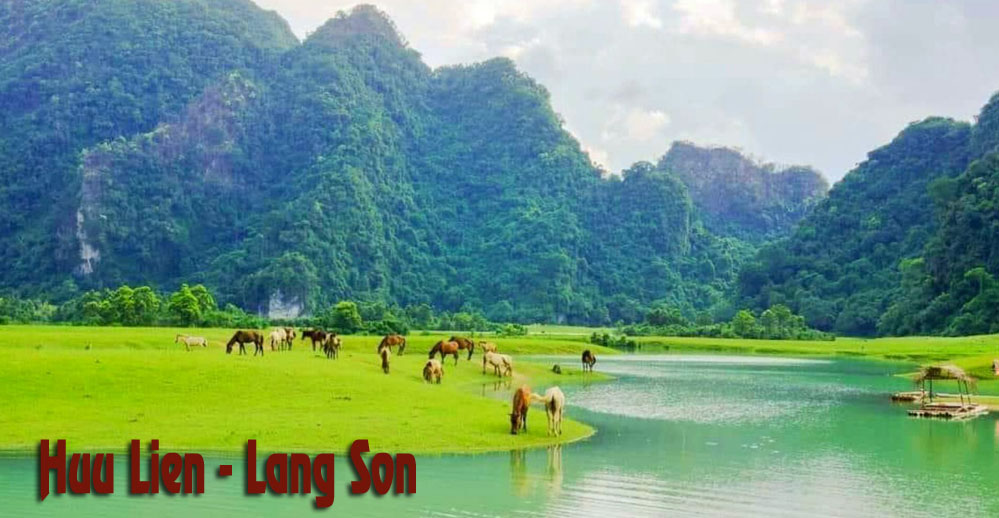
Not far from the commune center, Dong Lam unfolds before
visitors a vast space with green grassy slopes, surrounding
limestone mountains, and a winding stream. At times, herds
of horses graze peacefully on the grassland, creating a
scene typical of the mountainous region.
What's fascinating about Dong Lam is its
ever-changing landscape. During the dry season, the lush
green meadows at the foot of the mountains expand, perfect
for picnics, trekking, photography, horseback riding, and
camping. When the rainy season arrives, the rising water
creates vast flooded areas, transforming Dong Lam into a
unique and picturesque landscape. This seasonal change is
what gives Dong Lam its special charm: each return is a
different experience.
While Dong Lam boasts a expansive beauty, the Nong Dung lake
area offers a more tranquil atmosphere. A kayak, a paddle,
and calm water amidst the mountains and forests - sometimes,
that's all you need for an afternoon. There are no engine
noises, no crowds of mass-market tourist spots; only the
sound of paddles, the wind, and the reflection of the
mountains. Experiential activities such as kayaking,
camping, trekking, and nature exploration are enriching Huu
Lien's tourism offerings. This is also a direction aligned
with the trends of ecotourism and community-based tourism.
These figures show that tourism is no longer solely the
responsibility of businesses or government agencies. A stilt
house can become a homestay; a family meal can become a
culinary experience; a story about a traditional craft can
become a cultural product; a local person knowledgeable
about mountain roads can become a local guide. When people
directly participate in and benefit from tourism, protecting
the landscape, preserving culture, and improving service
quality also become intrinsic needs of the community. This
is the crucial foundation of sustainable tourism. For Lang
Son, the growth figures for 2026 show that the market is
expanding. For Huu Lien, new steps in infrastructure,
products, and community tourism are laying the groundwork
for a new phase of development.
From the center of Lang Son to Mau Son, through Bac Son and
then to Huu Lien, the journey to explore Lang Son today is
no longer just a sightseeing trip. It is a journey to
discover geology, ecology, culture, and community, where
every mountain, stream, stilt house, and local meal
contributes a story to the new tourism landscape of the
Northeast region.
Ethnic Travel
Vietnam is a leading tour company in Hanoi, Vietnam,
offering personalized travel experiences and a wide range of
services such as airport transfers, accommodation and flight
bookings, and tailored itineraries. With a focus on
sustainable tourism, we provide low-impact tours and curate
activities in popular destinations like Hanoi, Hoi An, Nha
Trang and Ho Chi Minh city.


